Thursday, September 28, 2017

Graphic Design: Branding

In design, branding is one of the most crucial and basic foundations that drive success toward a designer's goal. To start, branding is the process of creating an identity for a 'brand', which is simply, an organization or company who may sell products or provide services. These brands also carry some sort of personality, which can be described by how their intended audiences/consumers view their brand.
A brand's identity is important, as it plays probably one of the biggest roles in a company's success. Branding comes into play when consumers look at a certain company and immediately have a first impression based on what they see in either the products or visual representatives of the service the company provides.

There are three main parts that go into a brand's entire identity: brand, identity, and logo.
A brand is the perceived emotional corporate image as a whole.
The identity includes visual aspects utilized by the overall brand.
And finally, a logo is the symbol or mark that distinguishes or identifies the business.

Using Apple as an example, their "brand" is a multinational technology company. Each brand has its own voice which determines the message the company wants to communicate to their audience. In Apple's case, it is success and sleek innovation in the advancement of technology and devices. 
Their "identity" includes the color scheme, marketing material, product and package design, apparel design, and basically any other form of visual representation of the company. For Apple, they're known for their sleek, modern, luxurious looking products, as well as the way their website, stores, and advertisements look.
Logo, is the simplest form of the brand. It is simply used to identify out of the millions of other businesses. Apple's logo is their apple symbol, a simple, grey/white/or black apple with a bite out of the side. This simple design can be recognized all over the world as the company is internationally successful.

Thursday, September 21, 2017

Graphic Design: Principles of Design

Designers use elements in their designs that are used in artwork. Principles are a concept of design that helps organize or arrange certain aspects in one's work. These principles are applied to affect the content of the work, or the message being communicated.

The main principles are:

Balance - the distribution of the visual weight of objects, colors, texture, and space

Proportion - the feeling of unity created when all parts relate well with each other

Rhythm - created when one or more elements of design are used repeatedly to create a feeling of organized movement

Emphasis - the part of the design that catches the viewer's attention

Unity - the feeling of harmony between all parts of the work of art

There are many other principles, however these are the most basic ones that are utilized in art and design.
These principles can be seen anywhere, from logos to signs. Even just looking up at the menu at McDonald's, you can observe the way these principles were used in the arrangement of the entire layout.

Thursday, September 14, 2017

Graphic Design: The Meaning of Colors

We never really think about it, but everywhere we go and everywhere we look, there is a constant message being communicated by the colors we see in objects and shapes.
Though we don't give it much thought, colors affect our emotions and perceptions of places and even ideas. For example, companies use specific colors to evoke different feelings that will either persuade or inform their targeted audience.
This concept is called "color psychology".

Different colors represent varying meanings and can potentially have multiple emotions attached. In a more basic understanding, darker colors may have a slightly more "negative" feeling than lighter, brighter colors do. However, each color in a broader spectrum has its own unique "feeling" that changes a viewer's own opinion of whatever is presented in front of them.


Consider the company Apple. To the general public, they are a well trusted, reliable, powerful brand. While all of this is due to their outstanding products and services, the design of their entire company as a whole plays a big role as well.
The main colors of their brand include silver, white, and black. These simple colors stay consistent within their brand, as shown in their logos, products, website, and any other visual representation of their company.

As shown in the color chart, the color silver symbolizes glamour, high tech, and sleekness. All which describe the Apple brand very well. Their signature silver color on their Macbooks as well as their phones make consumers feel almost luxurious with Apple products. Having a Macbook laptop with their iconic logo also plays into their universal recognition as a company.

Besides Apple, all companies use color psychology in the development of their companies. Designers must consider their usage of colors, and also what each color will communicate to their audiences. Colors affect the mind much more than we think.

Monday, December 19, 2016

Semester Reflection

What did I do?

This semester, I had a lot more experience and projects involving client work compared to last year in e-Comm. As a class, we made promotional videos the 21st Century Academies, one for the programs in general, and an informational video for each academy. 


Our first video was entered in the CTE Month contest. The purpose was to encourage incoming high school freshmen to join an academy at one of the Olathe high schools. Following this general promotional video, a more detailed video with information about the specific academies was the next project.

The Academy that I was responsible for was the Business Finance Academy, along with one of my classmates. For the video, we shot two different interns at their internships to get a better look at what the academy can potentially offer. This video had taken the longest to shoot and edit, especially since the academy has not yet been created until next year. Since we couldn't get actual footage of the not-yet-made academy, we improvised and had actors read a script of what the future academy will be about.


Strengths & Improvements

My strengths that I've found this semester are mainly preproduction skills. I've become very organized about when to shoot and shots that I need, especially when I filmed the Business Finance Academy video. I do need improvement on editing, I still have trouble editing audio and learning how to edit certain shots a certain way to make the footage flow better overall.

Things I Learned

I've learned a lot more about collaborating and doing client work this semester. After a lot of focus on client work, I learned more skills and what it takes to make a quality video.
In addition, I was a part of the group that wrote our short film script, which I enjoyed. I've learned what goes into writing including the action and dialogue and how important it is to keep the characters consistent throughout the film.

Action Plan & Growth

I've enjoyed this semester and have had new experiences to learn from. Next semester, I plan to apply the skills I've learned this year and hopefully incorporate them to my work next year.
I plan to continue being a part of the short film and involve myself as much as I can with filming, despite the changes in my schedule next semester.

Thursday, December 15, 2016

Making of a Short Film

Pre-production

In my film class, we started preparing for our short film to shoot by next semester. Our goal was to have a script ready by the end of first semester, which we did eventually (sort of) accomplish. Earlier in the year, we began with several ideas and it was apparent that as a class, we couldn't settle on just one and go with it.
We had difficulties staying interested in a story idea, up until we decided to base our story on a true story that happened to on of my classmate's family. As soon as we heard the whole situation, the news itself sounded like it already came straight out of a movie. 

Pre-writing

After unanimously agreeing with the idea, we set up a writing team which consisted of me and five others in the class to be in charge of writing a rough draft of the script. Before trying to type up the script on a document, we roughly sketched two timelines to keep track of the story and how the film will be shot. The first timeline we drew is of that actual story, how it plays out and when, in relation to each other. That one is just for our reference. Then our second timeline we made is how the story plays out in the film in chronological order.

Actually Writing

Once the timeline was done and we agreed on the plot, we started on the script. A few things I've learned during the writing process is that writing dialogue is HARD. And writing dialogue and simultaneously avoiding cliche's is even harder. But I've found writing the script and getting into the characters' heads is actually interesting and I genuinely enjoy getting to help decide what each character says or how the action plays, etc.
For our film we wrote a rough draft, mainly focusing on the action and leaving the dialogue to be fixed later when we go through the script as a class. So far, I'm pretty satisfied with our rough draft and think it will tell a very interesting, suspenseful storyline.

Wednesday, December 14, 2016

It's A Wonderful Life - Analysis

A Holiday Classic

The movie, It's A Wonderful Life, is a great holiday film noted as a classic. It tells a heartwarming story that stays relevant even in modern times. Narrated by "angels", the story is about a man, George Bailey, who decided to attempt suicide due to his struggles with self-image, family, and financial situation. In order to "save" him, an angel comes down to show Bailey how his life would have been if he had never been born. Only then does Bailey realize his own value to his family and town.
As a classic, the story is timeless and memorable and teaches us to be thankful, which is always a good reminder especially during the holidays.

Beat Sheet

Opening Image – The film opens with narration by angels, shown as stars. They begin talking about the story of a man named George Bailey.
Set-up – George is introduced as a boy who saves his own brother, as a result he lost his hearing in one ear. The town he lives in is Bedford Falls and he stays there for his whole life. 
Theme Stated (happens during the Set-up) – The moral of the story is of course to be thankful and realize your own worth and value to those you love. George Bailey learns this the hard way through his hardships.
Catalyst – After his father died, George takes up the responsibility of keeping the bank to prevent the wealthy but evil Mr. Potter from taking over. 
Debate – By being in charge of the bank, George is forced to give up his dreams of leaving Bedford Falls and wanting to travel and build.
Break Into Two (Choosing Act Two) – He chooses to stay in Bedford to save the bank and the people in the town who rely on him for their loans, meanwhile his brother is a war hero in the second world war away from home.
B Story – George discovers his love for his childhood friend Mary, who has been trying to get his attention for a long time, yet George has been ignoring her until she sees him again after being out of town.
The Promise of the Premise – George finally gets married to Mary and they begin their journey as a married couple in Bedford Falls with their own house that Mary dreamed of and keeping up with the bank.
Midpoint – As the story goes on, George becomes more regretful about his life and how he has given up his dreams to travel. He lives a steady, not too exciting life in Bedford. 
Bad Guys Close In – George becomes jealous of his friends who get to travel, meanwhile money that was supposed to be put in deposit into the bank gets lost and the news is brought to George. George becomes stressed and frustrated with the situation, knowing that he can be arrested for the loss of money.
All is Lost – With the money in Mr. Potter's possession, he sabotages George Bailey's career by calling the police for his arrest after George turns down his offer of working with Mr. Potter.
Dark Night of the Soul – George comes home after the horrible news with Mr. Potter, the arrest, and the state of the bank. He argues with his family and intimidates his children and wife, Mary. He storms out of the house and gets into a car wreck, then ends up at a bridge, about to take his own life.
Break Into Three (Choosing Act Three) – An angel comes to "save" George's life, and then grants his wish to "never have been born". George is then forced to watch the town of Bedford turn into a miserable place and the people he used to know are not the same, all because George had never been born. He realizes how much of an impact he has created and changes his mind about his perception of life. 
Finale – George gets his actual life back, where his family and neighbors know him and the town is the same and in much better condition with him being there. He goes back to his house to find his children and wife, also finding the cops there waiting for his own arrest.
Final Image – Many people of the town, including his brother who has come home, arrives at George's house. They all sing Christmas carols and the police rip up the warrant for arrest and join along in the holiday spirit and all is merry and they have a Happy Christmas.

Wednesday, September 7, 2016

Toy Story 3 - Beat Sheet


Opening Image – most of the characters from previous Tory Story movies are introduced, they’re in one of many adventures played and created by Andy, it’s revealed that it’s an older video of Andy playing with his toys

Theme Stated – Andy is going to college and Woody wants himself and all of the toys to be there with him

Set Up – Andy isn’t as interested in playing with his toys, he has grown up and ready to move on to college, his boxes are ready to leave and the toys want to make sure they make it into the things he takes with him to college

Catalyst – Andy’s toys are put into a trash bag that his mom mistakes for trash, so she takes it outside then Woody goes to save the mix-up before the garbage truck makes it

Debate – the toys are convinced that Andy doesn’t want them anymore, however Woody is still insisting that Andy does care and that they should be there for him, the toys decide that they go to Sunnyside instead for a better life

Break into two – they arrive at Sunnyside daycare and at first glance everything looks great, they meet new toys who seem nice, Woody is still convinced that he would be needed by Andy

B story – while the toys are at Sunnyside with the younger kids in the daycare, Woody escapes to return to Andy

Fun and games – Bonnie, this little girl, finds Woody and takes him home, while at Sunnyside, the toys realize their daycare isn’t as fun as they thought it would be, Buzz wants to talk to Lotso to talk to them about changing their age group, however he learns that the group of toys that welcomed them in are not good toys and Buzz gets reprogrammed by Lotso

Midpoint – the toys are locked up and controlled by the bad Sunnyside toys, Woody goes to rescue his friends at Sunnyside

Bad guys close in – lotso’s toys patrol the daycare during the night, but the toys have a plan to escape and everyone is working together in their own tasks

All is lost – all the toys make it to the garbage chute, but at the last second lotso appears to stop them from escaping, the baby throws lotso into the bin and woody is grabbed by the foot by lotso. All of the toys get thrown into the bin after trying to save woody

Dark night of the soul – all of the toys were so close to escaping but they all somehow find their doom in the garbage bin, plus they’re all stuck in there with lotso, they all fall into the pit where the trash goes to burn in the fire and they all brace each other and are ready

Break into three – a giant claw saves the group of toys from being burned (and of course it’s the little aliens), the toys are saved, lotso is taken away by a driver

Finale – the toys make their way to Andy’s by getting on a garbarge truck that’s on the way to Andy’s house, they make it into the house and into the box set for attic while Woody plans to go into the box for college. Woody writes Bonnie’s address for the box that’s supposed to go to the attic and Andy goes to drop the toys off


Final image – Andy shows Bonnie all of the toys to her and they play together and with andy one last time

Friday, March 25, 2016

A Thousand Words - short film


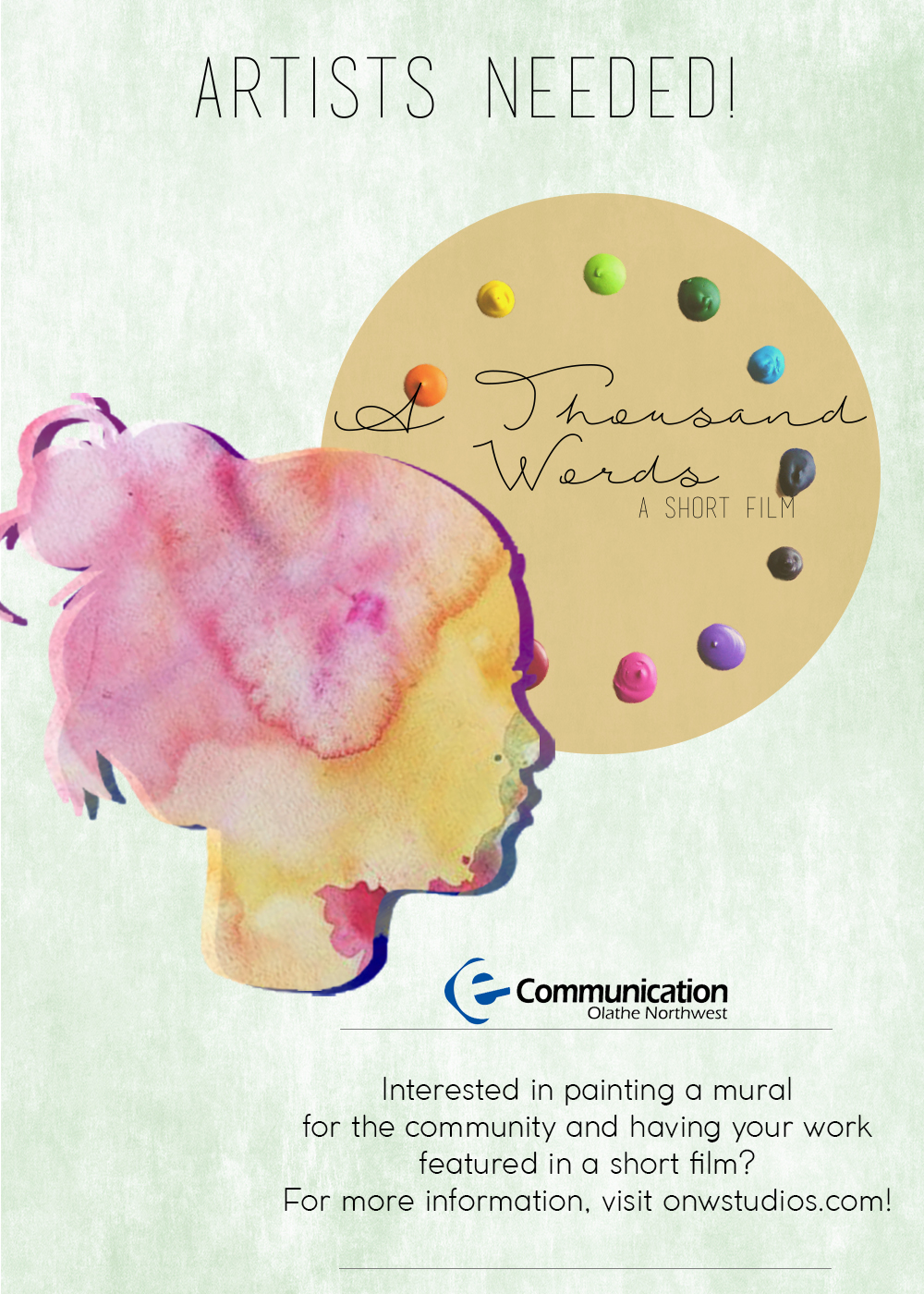
Since this semester started, our class has been working (and struggling) to determine our short film plans. After much debate, we all decided on producing one movie, titled A Thousand Words, which is about a young writer who's experiencing writer's block and lacks any inspiration for her work. She then goes out and finds girl who is mute, and watches her paint a mural, which triggers her inspiration for her writing.

This movie has become more of a community statement, involving students from multiple schools and getting people all over the city to support the movie and its message. Our plan is to find a building or wall to paint the mural on, preferably a setting where traffic is heavier and people who drive or walk by it have easy access to seeing the magnificent mural. The mural itself will be painted by a group of recruited artists from all over the community who are willing to become involved in a great project.

My role as the publicist is to provide the artwork that is advertised such as our artist flyer and logo design. The other roles of the publicity team include social media, such as our Twitter and Instagram, to further promote and update our production.


Monday, January 25, 2016

Self Portrait


My first project of the new year was to make a "self portrait" video. This had to basically depict/represent ourselves as an individual and it could be as abstract as we want. The way I interpreted this project was to go with a "day in my life" theme.

What I wanted to show in my video was that I'm easy going, love music and being creative. I began by getting shots of my room, which in a way kind of represents who I am and what I like to do. The footage I got were just panning shots of my walls that included some art, I also included objects in my room like my guitar/piano.Other than that, I took my camera with me while hanging out with my cousin, who goes everywhere with me. We took a long drive and the timing ended up being perfect since the sunset that night was beautiful.

I edited the whole thing as a montage and included my (temporary) logo in the beginning of the video. This project was fairly easy to do and fun for the most part. Most important thing I think I've learned from it was that my camera battery does not at all last as long as it should and its annoying how many times its died on me while getting footage.

Friday, December 11, 2015

6 Second Entertainment

Without a doubt, we are advancing into a more digital world where the majority of what we use to function or view are done predominantly on these flat rectangle surfaces called screens. Ranging from massive projected images on a wall in movie theaters, to a tiny 5 x 2 computer that fit in the palm of our hands, we as a human race have found a tremendous amount of ways to entertain ourselves. Media as a whole is becoming more and more brief as technology progresses to feed us information quicker than ever, just with a few clicks of your mouse (or finger).

Thanks to our advancing technology, people are now able to access any possible resource, whether that be books, movies, ways to contact people, and even find out how to get from right where you are standing to a certain spot in the country. In many aspects, this exposure to data at such an immediate rate has affected not only how we obtain information, but the length of our attention span as well.

Take motion picture for example, early movies and shows have been a form of entertainment ever since the invention and advancement of the camera. The length of motion pictures can play such a large role in how well people will be willing to continue watching. The success in amusing a person all depends on how well a story is told, time being a big factor. 
Nowadays, it is so easy to not only capture someone's attention, but to also lose it. Digital media has evidently caused our attention spans to shorten. This can be shown through sites like YouTube, where if the length of a video is too long, many people tend to click away. Videos being produced have become shorter and shorter to an average of 3-4 minutes on YouTube. And somehow, people have found ways to fully tell a story in just 6 seconds!


I am specifically referring to Vine, one of the most popular social media apps accessible on any smartphone. Vine is the prime example and proof that our attention span has become smaller. It takes creative minds (and probably people who have nothing better to do) to come up with a way to entertain in using only 6 seconds, and sometimes even less.


Personally, I think it's amazing that we can even comprehend what happens in that short amount of time. A variety of videos are posted each day on Vine, then shared on other social media such as Twitter. Whether they're humorous, informational, promotional, or even just used to express thoughts and opinions, these short clips can easily capture anyone's attention and even with a few seconds, can have great quality.

Wednesday, December 9, 2015

College Bio Project

During ONW's annual Blood Drive, a group in my college biology class had taken advantage of the event to film a quick and fun video for our project. Since I'm in E-Communication, I had the idea to take responsibility of the actual video production and film part of the project, which means storyboarding the preproduction, coming up with ideas and organizing how and when to shoot, and also I had the responsibility of editing.


The scope of our project was to explain the concept of blood cells along with how it ties to cell diffusion and osmosis.  My group had come up with the idea to interview random students who were at the blood drive and we all wanted the responses to be unexpected and funny. We had less than two days to shoot during school, however only one day to be at the Blood Drive and get footage from that event. My teacher had also only given me one day to edit, so we were pretty limited on time to complete this entire project. 

As I came up with the general storyboard and organized how were going to shoot, the rest of my group created the content that would be in the video and how to include all of the biology that we had learned. Then, on the day of the Blood Drive, we checked equipment out and went to the flex theater to shoot.
Filming the interviews didn't go too bad, the only downside was that we were very limited on time and had a lot of footage to shoot, at least for the biology side of the video. We had prioritized the biology content first, then worried about the interviews and having fun after, which resulted in a short amount of time to find many students who would be willing to be in our video.

After getting all of our footage, I edited (mostly by myself) and clipped together all of the interviews along with the information about diffusion. I tried to edit in the way that ONW's segment "Word from the Halls" does, with quick cuts and random sound effects. After watching the finished video, I feel like I could have done much better on the editing and it could have been longer with better content if I had more time to edit. During the editing process, I relearned shortcuts on Final Cut that I've forgotten and overall gotten more familiar with the editing software. All in all, I feel pretty satisfied with our video and my group ended up winning a prize out of other groups in our class. 

Monday, November 30, 2015

Developing Our Short Film

Story Developing and Script Writing

For my class's short film, I've recently been involved in helping writing the script, along with a few others who have created the story. Throughout the process so far, I've learned many techniques and skills, and overall I've gotten more dedicated to our story and not to mention I've grown closer to my classmates.

Everyday for the past month, we sit in the conference/studio room with the script projected on the TV that's mounted on the wall and discuss ideas and how the script will play out.
I should probably mention that when we first developed our film idea, the entire concept was COMPLETELY different than what it is currently.. (Long story short, our original story was too risqué and we couldn't film it due to the risk that it would lead to a very admired teacher being fired).


example of our not yet developed ideas


After several modifications and ideas straying far from the original plot, we finally have a developed storyline. One that includes interesting reversals and twists that will play with the audience's minds. Through the process, I've learned much about story developing and how to create interesting characters that the audience will either sympathize with or absolutely hate. 

Before even beginning to write the script, we wrote a short analysis on each of our key characters. We wrote their age, background, history, what their passions are, the experiences they've been through, and really as much as we can come up with about the person. This helped us get a feel of how each character would talk, react, and think as the story goes on. After writing each analysis on them, during the writing process, if we needed help with what a character would say or feel, we'd refer back to this document.

With the help of Alex Noury (this cool former student who's had experience in LA and came back to ONW to teach about story developing), we began to finally write our script on Celtx. The main writer and person responsible for our story concept is Clayton. He was in charge of actually physically typing out the script and the majority of the credit for the story goes to him.


first page of script on Celtx

Overall, the process of writing the script was very interesting and I feel like I've learned a lot from this experience. Because our story included many twists and reversals, we had to contemplate exactly how each character would think, react, and what they would want others around them to see and what the audience actually sees. I never actually thought that this much thinking and consideration goes into writing, but after this process I've learned so much and love how much thought goes into writing. I think its so interesting how much you can easily play with feelings and surprise the initial judgments of characters.

Tuesday, November 24, 2015

20 Steps Challenge


20 Steps

For this week's project, we followed a challenge on vimeo, where the rules are to take 20 clips after every 20 steps in one area. The purpose is to tell a story from your point of view using different angles and being creative with your 20 shots.

My cousin and I went to the lake one day, and I decided to bring my camera along to film for this project. I made a quick short list of shots that I knew I wanted to include, then when we got there, I spontaneously filmed the rest of the clips I wanted as we walked around. I made sure to get beautiful shots of the water and other random shots of plants and the sky to include variety in the video. I wanted to continue filming after sunset, however my camera battery died in the middle of shooting. On the bright side, I had more than enough footage to edit and use.


The editing process went fairly quick and easy. I tried to keep the shots in order as much as I could, that way it would show the point from where we started, then down to where we stopped walking, which was the dam on the other side. From this project, I learned a couple things: 1) I should fully charge my  battery before leaving the house 2) I still need to learn how to keep a steady hand with my camera and lastly, 3) favorite more precise clips in Final Cut to make it easier to find exactly the shot I'm looking for.

Monday, October 5, 2015

Short Film Shot On iPhone?

Potential of Smartphones


Recently, a journalist group, RYOT, have made the first 4k short film using the new iPhone 6s. After watching this, I agree with NoFilmSchool, that this reveals the potential that smartphones have of being a powerful tool for film and can even change journalism.


RYOT captured impressive shots of the location, using their iPhone 6s. However they did use lens and stabilizers which definitely helped the quality, but overall you can see the quality the iPhone camera itself already provides which is comparable to DSLRs and high end cameras.


The author gives the short film video itself and also the behind the scenes video, then follows with examples comparing iPhones' cameras throughout the years. They include various pictures comparing each phone with different tests such as macro, backlit, and sunset. He also claims that smartphones have the ability to become very powerful in filmmaking and can influence filmmakers as technology advances.

Overall, I enjoyed reading this article and what the author has showed with the ability of smartphones, since most people, if not all, have one right in their pockets including me. This was interesting and has given me many ideas and inspiration to do more with my own phone and learn how to take advantage of its quality. 

  • Website Title: No Film School
  • Article Title: Check Out the First 4K Short Film Shot Entirely on an iPhone[…]
  • Date Accessed: October 05, 2015

Wednesday, September 23, 2015

Shutter Speeds vs. Frame Rates


The way frame rate and shutter speed can be adjusted can greatly affect an audience's emotion toward a certain scene.

On No Film School's article, frame rate is defined as the number of frames captured per second, and shutter speed is duration of time each frame is exposed to light. They say the basic rule is: the standard setting for your shutter speed is double your frame rate. 

The author does a great job at showing examples of how higher frame rates can benefit slow motion shots and also how fast shutter speeds result in clear images. The article provides two videos to show these examples. However, the author could do better by explaining more variations of how shutter speed and frame rate affect other types of desired shots to create different effects. In general the author briefly informs about how adjusting these two settings can help create a better desired effect.

The author did support his main argument, but the article was short and only showed two specific examples. The evidence provided by the videos were convincing and very informative. In the future, I plan to use what I've learned from this article to make shots in my videos better and find ways to help tell the story. 

  • Website Title: No Film School
  • Article Title: How Shutter Speeds & Frame Rates Can Be Used to Change t[…]
  • Date Accessed: September 23, 2015